 ultimate-guide
Cantilever Bridge Dental: What You Need to Know
Table of Contents
- What Is a Cantilever Dental Bridge?
- How a Cantilever Bridge Works
- Dental Bridge vs Implant: Which Suits You?
- Dental Bridge Lifespan and Long-Term Outcomes
- Frequently Asked Questions
Last Updated: September 4, 2026
A cantilever dental bridge is a fixed dental prosthesis that replaces a missing tooth by anchoring a pontic to a single adjacent abutment tooth. Unlike a traditional bridge, which requires crowns on two neighbouring teeth, the cantilever design attaches on only one side of the gap. The decision often comes down to the gap location and the health of the supporting tooth.
What Is a Cantilever Dental Bridge?
This approach suits anterior teeth, where occlusal forces are lighter. The main appeal is that it preserves adjacent healthy teeth, requiring crown preparation on only one tooth rather than two. However, the single-sided support creates a lever effect that transmits torque to the abutment tooth, which is why careful case selection matters.
How a Cantilever Bridge Works
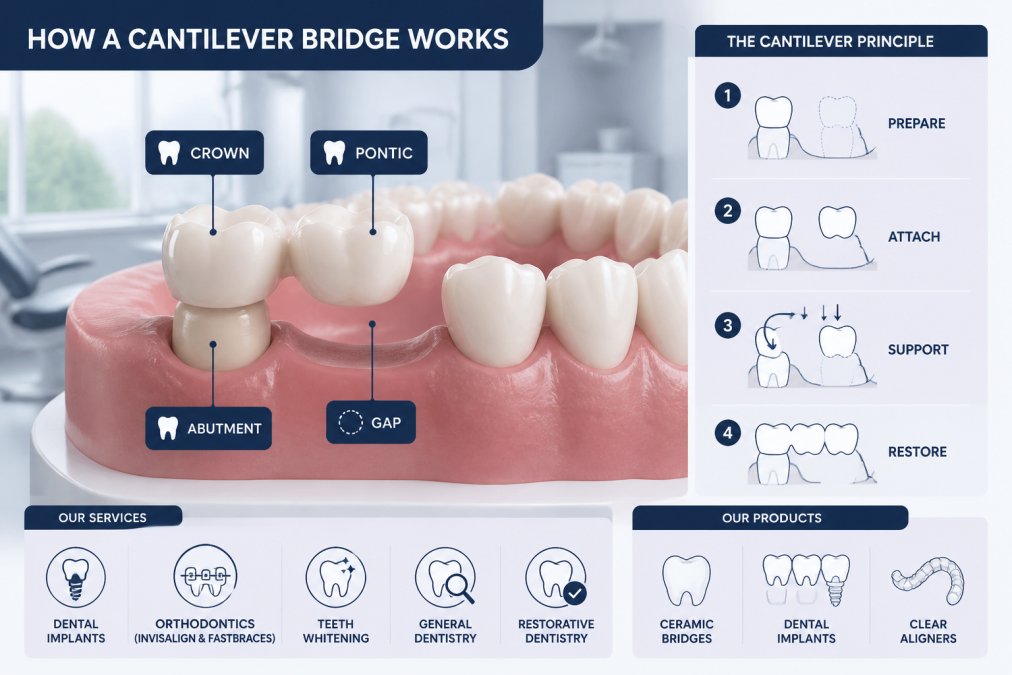
The cantilever bridge functions as a lever anchored to one abutment tooth. When you bite down on the pontic, the force transfers to the supporting tooth and periodontal ligament, rather than being distributed across two anchors as in a traditional bridge.
Preparation involves reshaping the abutment tooth, taking an impression, and fitting a temporary bridge whilst the permanent restoration is made. Materials include porcelain fused to metal or zirconia. Clinical suitability depends on bone density, root surface area, and bite alignment.
Dental Bridge vs Implant: Which Suits You?
A bridge requires grinding down healthy neighbouring teeth for crown support, whilst an implant replaces the root and leaves surrounding teeth untouched.
Implants offer osseointegration, where the titanium post fuses with the jawbone, preserving bone density and avoiding torque issues (peer-reviewed research). The trade-off is that implants involve surgery and a longer timeline. A bridge can often be completed in a few weeks with no surgical phase.
The table below summarises the main differences:
| Consideration | Cantilever Bridge | Dental Implant |
|---|---|---|
| Adjacent teeth | One tooth prepared | None affected |
| Procedure | Non-surgical | Surgical placement |
| Bone preservation | Limited | Maintains bone density |
| Treatment time | Weeks | Several months |
| Best for | Front teeth, single gap | Most missing teeth |
For many patients, implant longevity makes it the stronger long-term investment, particularly for posterior teeth. A cantilever bridge remains a legitimate choice where implants are not suitable, such as when bone density is insufficient or surgery is not advisable.
Dental Bridge Lifespan and Long-Term Outcomes
A cantilever bridge typically lasts five to fifteen years with proper care, though the design tends to have a shorter lifespan than traditional bridges because of increased stress on a single abutment tooth (peer-reviewed research).
Maintaining good oral hygiene is essential, as gum disease and tooth decay at the crown margins are the most common reasons for failure (peer-reviewed research). Regular check-ups allow early detection of cementation breakdown or abutment issues.
Clinical evidence generally favours implants for longevity, offering a more durable solution that protects surrounding bone. A thorough clinical assessment is the essential first step in determining which approach suits your situation. At Rodney Street Dental, our team provides bespoke treatment plans so you understand every stage before committing. Contact us to arrange a consultation and explore which restoration option fits your smile.
Choosing the right restoration involves balancing preservation of healthy teeth, durability, cost, and your personal preferences. At Rodney Street Dental, we offer comprehensive restorative options, including dental implants, alongside cosmetic treatments such as professional teeth whitening, all delivered in a calm, welcoming environment. Our CQC and GDC registered team prioritises your comfort and safety with fully bespoke treatment plans. Get started with Rodney Street Dental and take the first step toward a confident, healthy smile.
Our Services and Products:
- Dental Implants
- Orthodontics (Invisalign, Fastbraces)
- Professional Teeth Whitening
- Routine Check-ups
- Bespoke Treatment Plans
- Trusted Brands: Straumann, BioHorizons, Boutique Whitening, Philips Zoom
Frequently Asked Questions
How long does a cantilever dental bridge last?
A cantilever bridge typically lasts 5 to 15 years with proper care, though longevity depends on oral hygiene, bite forces, and the health of the abutment tooth. Regular brushing, flossing, and professional check-ups extend its lifespan. Unlike dental implants, which rely on osseointegration into the jawbone, cantilever bridges depend entirely on the supporting abutment tooth, making their durability more variable.
Why is a cantilever bridge often not recommended for back teeth?
Posterior teeth experience greater occlusal forces during chewing. A cantilever bridge, which extends from only one abutment tooth, concentrates these forces unevenly, increasing the risk of abutment tooth failure and bridge fracture. Traditional bridges or dental implants distribute forces more evenly and are preferred for molar replacement where structural integrity is critical.
What is the main difference between a cantilever bridge and a traditional bridge?
A traditional bridge is anchored by abutment teeth on both sides of the gap, distributing forces evenly and providing greater stability. A cantilever bridge uses only one abutment tooth, making it suitable only for smaller gaps in lower-stress areas, typically anterior teeth. The single-sided support makes cantilever designs more prone to torque and failure over time.
This article was written using GrandRanker