 ultimate-guide
How Long Do Teeth Whitening Results Last?
Table of Contents
- How Long Do Teeth Whitening Results Last?
- Professional In-Office Whitening Duration
- At-Home Whitening Trays and Strips Duration
- Professional vs At-Home Teeth Whitening Longevity
- Key Factors Affecting How Long Whitening Lasts
- Foods to Avoid After Teeth Whitening
- Teeth Whitening Maintenance Tips to Extend Results
- How Often Can You Whiten Your Teeth?
- Conclusion
- Frequently Asked Questions
Last Updated: July 9, 2026
How Long Do Teeth Whitening Results Last?
Understanding how long teeth whitening results last is crucial before committing to treatment. Professional in-office whitening typically delivers results lasting 6-12 months, while at-home systems maintain visible whiteness for 3-6 months before noticeable fading begins. The difference matters because your investment should align with realistic expectations about longevity.
Professional treatments outperform over-the-counter alternatives in both speed and durability. According to American Dental Association guidance on cosmetic dentistry, professional-grade bleaching agents contain higher concentrations of active whitening compounds, explaining why results last significantly longer. Three factors determine longevity: the strength of the bleaching agent, your maintenance routine consistency, and lifestyle habits around staining foods and beverages.
Professional In-Office Whitening Duration
Professional teeth whitening performed in a dental office delivers the most dramatic and longest-lasting results available. The treatment typically takes 60-90 minutes in a single appointment, with immediate whitening that continues developing over the next 24-48 hours.
Most patients experience results lasting 6-12 months, with some reporting visible whiteness for up to 18 months when strictly adhering to maintenance protocols. Longevity depends on the specific whitening system used (Philips Zoom and Boutique Whitening tend to produce durable results), your baseline tooth shade, and how aggressively you expose teeth to staining agents afterward.
Professional treatments last longer because dentists apply bleaching gels containing 25-40% hydrogen peroxide or carbamide peroxide directly to teeth, often with light activation. This controlled environment prevents excessive gum contact, and higher concentration penetrates deeper into the dentin layer where permanent color changes occur. At-home products use 3-10% concentrations, significantly weaker but safer for unsupervised use.
At-Home Whitening Trays and Strips Duration
At-home whitening systems deliver more modest results that fade faster than professional treatments. Custom trays prescribed by a dentist typically maintain noticeable whiteness for 3-6 months, while over-the-counter strips usually show fading within 1-3 months.
Custom trays filled with dentist-prescribed gel (typically 10-15% carbamide peroxide) work more effectively than strips because they maintain contact with all tooth surfaces for extended periods. Strips cover only front-facing surfaces and may not reach the sides evenly.
At-home treatments require daily or nightly use over 1-2 weeks to build up to professional-level whiteness. This slower process offers an advantage: teeth acclimate to bleaching agents more gently, reducing sensitivity for many users. However, the gentler approach means results don't penetrate as deeply, so whitening fades faster once treatment stops.
Professional vs At-Home Teeth Whitening Longevity
Professional in-office treatment wins decisively on longevity: you get 6-12 months of results from a single 90-minute appointment, whereas at-home trays require 1-2 weeks of daily commitment for 3-6 months of results.
Cost-per-month analysis favors professional whitening when factoring in longevity. A single professional treatment delivers results lasting twice as long as at-home systems. If you use at-home trays every 3-4 months to maintain whiteness, you're investing time and money multiple times per year. Professional touch-ups typically cost less per month than cumulative repeated at-home treatments.
The choice depends on your priorities. Professional whitening suits patients wanting maximum results with minimal effort and higher upfront costs. At-home systems work better for budget-conscious patients, those with sensitive teeth, or patients who enjoy controlling treatment timing.
| Whitening Method | Longevity | Upfront Time | Typical Cost Range | Best For |
|---|---|---|---|---|
| Professional In-Office | 6-12 months | 90 minutes | Higher investment | Maximum results, minimal effort |
| Custom At-Home Trays | 3-6 months | 1-2 weeks daily | Moderate | Gradual whitening, budget-conscious |
| Over-the-Counter Strips | 1-3 months | 1-2 weeks daily | Budget-friendly | Trial users, sensitive teeth |
Key Factors Affecting How Long Whitening Lasts
Several biological and lifestyle factors determine whether whitening results fade in three months or stretch toward a full year.
Enamel thickness and natural tooth color play foundational roles. Teeth with thicker enamel hold whitening results longer because bleaching agents penetrate gradually and structural density resists re-staining. Naturally darker teeth may not whiten as dramatically as lighter teeth, but they tend to hold results longer because whitening penetrates deeper into resistant tissue.
Lifestyle habits and staining agents represent the largest variable in longevity. Frequent consumption of coffee, red wine, tea, and dark sodas accelerates color relapse significantly. Tobacco use, whether smoking or vaping, introduces staining compounds that recolor teeth faster than any other single factor. Even frequent exposure to highly pigmented foods like beets, soy sauce, and berries shortens your whitening window if you don't rinse immediately afterward.
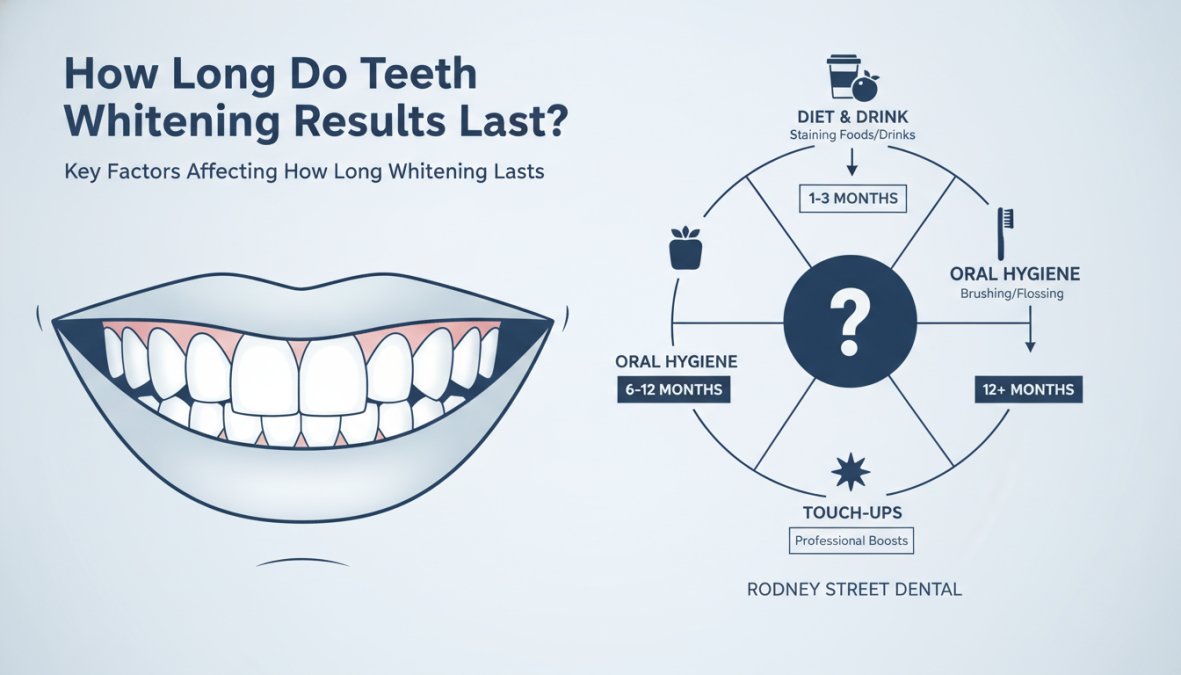
Oral hygiene consistency matters significantly. Patients who brush twice daily with whitening toothpaste and floss regularly maintain results 2-3 months longer than those with inconsistent routines. Saliva chemistry also influences longevity, some people's saliva provides better stain resistance than others, a factor you cannot control but one that explains why identical treatments produce different longevity across patients.
Foods to Avoid After Teeth Whitening
The first 48 hours after whitening represent a critical window where teeth are most vulnerable to re-staining. Your enamel is temporarily more porous from bleaching, and pigmented compounds penetrate more easily during this period.
High-risk foods to avoid immediately after whitening:
Dark-colored beverages top the list: coffee, black tea, red wine, cola, dark juices, and sports drinks contain chromogens that bond to newly bleached enamel. A single cup of coffee during the critical 48-hour window can noticeably reduce results.
Deeply colored foods present similar risks: red pasta sauce, soy sauce, balsamic vinegar, beets, berries, and dark chocolate contain staining pigments. Acidic foods and beverages (citrus fruits, vinegar-based dressings, carbonated drinks) soften enamel temporarily, making it more susceptible to staining.
Lower-risk foods during the whitening window:
Stick to white, light, and neutral-colored foods: white chicken, white fish, white rice, pasta with white sauce, white cheese, white yogurt, white bread, potatoes, cauliflower, and clear broths. These contain minimal pigmentation and won't compromise results.
The white diet needs to last only 48 hours post-treatment. After that window, your enamel re-hardens and becomes less porous, though limiting staining foods for at least one week maximizes longevity.
Teeth Whitening Maintenance Tips to Extend Results
Extending whitening results beyond the typical 6-12 month window requires combining daily oral hygiene, strategic dietary choices, and periodic touch-up treatments.
Daily oral hygiene practices form the foundation of result longevity. Brush twice daily with whitening toothpaste containing mild abrasives and whitening agents that gently remove surface stains. Floss daily to prevent plaque buildup. Rinse your mouth with water immediately after consuming staining foods or beverages. Electric toothbrushes remove stains more effectively than manual brushing.
Use a whitening mouthwash in your routine to help maintain brightness by removing surface stains and preventing bacterial growth that causes discoloration.
The white diet protocol after treatment extends beyond the initial 48 hours. While you can resume normal eating after two days, continuing to limit deeply staining foods for 1-2 weeks provides additional protection. This means being mindful about timing and quantity rather than permanent restriction.
Schedule professional cleanings every 6 months. Dental hygienists remove tartar and stains that home care cannot address, preventing the dull appearance that develops between whitening treatments.
How Often Can You Whiten Your Teeth?
The frequency of whitening treatments depends on your goals, tooth sensitivity, and how quickly results fade. Understanding safe whitening frequency prevents enamel damage while keeping your smile bright.
Frequency of touch-up sessions varies by treatment type. Professional in-office whitening can be repeated every 6-12 months safely. Most dentists recommend waiting at least 6 months between treatments to allow enamel to remineralize fully. At-home whitening with custom trays can be repeated every 3-4 months if using original trays and gel from your dentist.
The key safety consideration is enamel health. Whitening removes minerals from enamel temporarily, and excessive bleaching can cause permanent enamel thinning, increased sensitivity, and translucency. Spacing treatments appropriately allows enamel to recover between sessions.
Impact of smoking and vaping on whitening longevity cannot be overstated. Tobacco use dramatically shortens whitening results. Smokers often see visible yellowing return within 2-3 months, compared to 6-12 months for non-smokers. Vapers experience whitening longevity closer to smokers than non-smokers, as vape liquid compounds stain teeth similarly to tobacco.
Conclusion
How long teeth whitening results last depends on your treatment choice, maintenance commitment, and lifestyle habits. Professional in-office whitening delivers 6-12 months of results from a single appointment, making it the gold standard for longevity. At-home systems offer flexibility and lower upfront costs but require more frequent repetition.
At Rodney Street Dental, we use trusted brands like Philips Zoom and Boutique Whitening that deliver proven longevity when combined with proper maintenance. Our team creates custom treatment plans accounting for your tooth sensitivity, baseline shade, and lifestyle factors to maximize result longevity. We provide detailed maintenance guidance, from the white diet protocol to touch-up timing, so you keep your investment bright for as long as possible.
The difference between results that fade in three months and results lasting a year often comes down to discipline in the first 48 hours after treatment and consistency with maintenance afterward. Contact Rodney Street Dental today to discuss which whitening treatment aligns with your goals and lifestyle, and let our team design a maintenance plan that keeps your results vibrant for months to come.
Frequently Asked Questions
How long does professional teeth whitening last?
Professional in-office whitening typically lasts 6 to 12 months, depending on your lifestyle and oral care habits. Results can extend longer with proper maintenance, regular dental cleanups, and avoiding staining agents like coffee, tea, and tobacco. Custom-fitted professional trays may provide longer-lasting results than chairside whitening in some cases.
What foods to avoid after teeth whitening to maintain results?
After whitening treatment, avoid dark-coloured foods and beverages such as coffee, red wine, berries, soy sauce, and tomato-based sauces for at least 48 hours. Acidic foods and drinks can weaken enamel and accelerate colour relapse. Stick to a 'white diet' of lighter-coloured foods like chicken, white fish, and clear beverages to protect your freshly whitened teeth.
How often can you whiten your teeth safely?
Most dental professionals recommend touch-up sessions every 6 to 12 months, depending on how quickly your teeth stain. Professional whitening can typically be repeated more frequently than over-the-counter products. However, excessive whitening may cause tooth sensitivity and enamel damage, so consult your dentist before scheduling frequent treatments to ensure your dental health remains protected.
Does professional teeth whitening last longer than at-home treatments?
Yes, professional teeth whitening generally lasts longer than at-home options. In-office treatments use stronger bleaching agents like hydrogen peroxide and carbamide peroxide under professional supervision, delivering more dramatic results that persist 6 to 12 months. At-home trays and strips typically last 3 to 6 months. Custom-fitted professional trays offer a middle ground with results lasting 6 to 9 months when used consistently.
This article was written using GrandRanker