 blog
blog
Fastbraces for Crowded Teeth: A Complete UK Guide
Table of Contents
- What Are Fastbraces for Crowded Teeth?
- Fastbraces vs Invisalign for Crowded Teeth
- Fastbraces Cost UK: What to Expect
- Fastbraces Before and After: Real Results for Crowded Teeth
- How Fastbraces Technology Works
- Addressing Crowded Teeth and Bite Irregularities
- Patient Suitability and Treatment Planning
- Frequently Asked Questions
Fastbraces for Crowded Teeth: A Complete UK Guide
Last Updated: July 31, 2026
What Are Fastbraces for Crowded Teeth?
Fastbraces represent an accelerated orthodontic solution designed to straighten misaligned teeth in a fraction of the time traditional braces require. The system uses a unique triangular bracket design combined with a specially shaped archwire that applies consistent, gentle pressure to move teeth and correct the underlying bone structure simultaneously. Many patients complete treatment in 3-8 months, compared to 18-24 months with traditional fixed appliances.
Fastbraces vs Invisalign for Crowded Teeth
Choosing between fastbraces and Invisalign depends on your specific dental irregularities, lifestyle, and treatment priorities. Invisalign uses custom-made clear aligners that gradually shift teeth into position and works best for mild to moderate crowding. Fastbraces are fixed to your teeth and cannot be removed, meaning consistent, uninterrupted force application particularly effective for complex crowding patterns.
| Aspect | Fastbraces | Invisalign |
|---|---|---|
| Treatment Duration | 3-8 months | 6-18 months |
| Visibility | Noticeable brackets | Nearly invisible |
| Removable | No | Yes |
| Oral Hygiene | More challenging | Easier |
| Severe Crowding | Highly effective | Limited effectiveness |
| Comfort | Initial adjustment period | Minimal discomfort |
Fastbraces Cost UK: What to Expect
Pricing for fastbraces treatment in the UK varies based on case complexity and crowding severity. Treatment complexity is the primary cost driver; straightforward anterior crowding costs less than severe crowding affecting multiple teeth. Most UK private practices offer flexible payment plans, including interest-free arrangements or partnerships with dental finance providers.
When comparing quotes, ensure they include the initial consultation and scan, all appointments throughout treatment, emergency visits, and retention planning post-treatment.
For accurate pricing specific to your needs, contact a qualified orthodontist for a consultation.
Fastbraces Before and After: Real Results for Crowded Teeth
The transformation possible with fastbraces for crowded teeth is striking. Patients frequently report improved dental alignment, enhanced confidence, and better oral function within months.
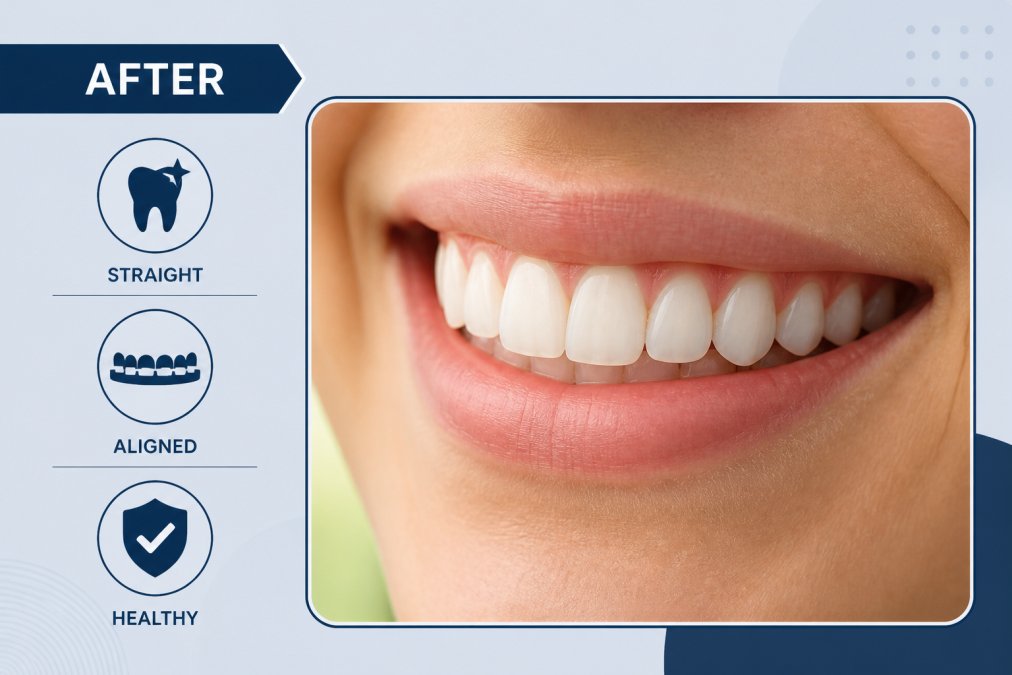
Real-world outcomes depend on initial crowding severity, patient compliance, and your orthodontist's skill. Cases involving mild to moderate crowding typically show visible improvement within the first month. Post-treatment, you'll wear a retainer, typically a fixed wire bonded to the back of your front teeth combined with removable aligners worn at night, to maintain your newly straightened teeth long-term. Many patients also choose to enhance their smile further with teeth whitening once their orthodontic treatment is complete, creating a brighter, more radiant result.
How Fastbraces Technology Works
Fastbraces rely on three key components: the bracket design, the archwire, and the biological response they trigger. Traditional brackets are rectangular and apply force primarily to the tooth crown. Fastbraces use a distinctive triangular bracket positioned closer to the gum line, allowing force to be applied at an angle that moves both the tooth crown and root simultaneously.
This dual-action approach is the secret to speed. The specially engineered archwire applies consistent, light force that stimulates bone remodelling without damaging the periodontal system. Throughout treatment, your orthodontist adjusts the archwire at regular intervals, typically every 4-6 weeks, fine-tuning force direction and magnitude.
Addressing Crowded Teeth and Bite Irregularities
Crowded teeth often coexist with bite problems, overbite, underbite, or crossbite, because they share a common cause: a mismatch between jaw size and tooth volume. Fastbraces address both simultaneously, making them particularly effective for complex orthodontic cases.
An overbite occurs when upper front teeth overlap lower teeth excessively; fastbraces correct this by repositioning both upper and lower teeth. An underbite, where lower teeth protrude past upper teeth, responds well to fastbraces. Crossbites, where upper and lower teeth don't align vertically, require precise force application that fastbraces provide. Correcting bite problems improves oral health by eliminating uneven tooth wear and reducing jaw joint stress.
Patient Suitability and Treatment Planning
Not every patient with crowded teeth is an ideal candidate for fastbraces. A thorough assessment by a qualified orthodontist determines whether this approach suits your specific situation.
Ideal candidates have moderate to severe crowding, good oral hygiene habits, and realistic expectations. Patients must be committed to maintaining excellent dental care throughout treatment. Age is not a barrier; fastbraces work effectively for both adolescents and adults, provided your jaw has finished growing. Certain conditions may make fastbraces less suitable: severe gum disease or active tooth decay requires treatment before orthodontics can begin.
Your initial consultation includes a dental scan, typically a cone beam CT or intraoral scan, that allows your orthodontist to visualise your tooth positions, bone structure, and bite relationship in three dimensions.
Crowded teeth affect your smile's appearance and your long-term oral health. Fastbraces offer a clinically proven way to straighten teeth and correct bite irregularities in a fraction of the time traditional braces require. At Rodney Street Dental, we provide comprehensive orthodontic assessments using advanced imaging and bespoke treatment planning. Whether you're interested in fastbraces, Invisalign, or other tooth-straightening options, our team prioritises your comfort, safety, and results. We also offer teeth whitening to complement your orthodontic treatment and help you achieve the bright, confident smile you deserve. Contact us today for a consultation and discover how we can transform your smile.
Frequently Asked Questions
How long does Fastbraces treatment take for crowded teeth?
Fastbraces typically treat crowded teeth in 3-24 months, depending on severity and individual response. Many patients see significant improvement within the first few months. The exact timeline depends on your specific dental alignment needs and how your teeth respond to the accelerated orthodontic technology. A consultation with a qualified orthodontist will provide a personalised treatment estimate.
What's the difference between Fastbraces and traditional braces for crowded teeth?
Fastbraces use a unique triangular bracket system and heat-activated archwires that apply gentle, continuous pressure to move both the root and crown of the tooth simultaneously. Traditional braces focus mainly on crown movement, which can extend treatment time. This accelerated approach can reduce overall treatment duration significantly whilst maintaining dental health and periodontal stability.
Can Fastbraces fix severely crowded teeth?
Fastbraces can effectively address moderate to severe crowding in most cases. However, the suitability depends on your individual dental anatomy, bone density, and overall oral health. Some complex cases may require additional interventions or a combination approach. A thorough dental consultation with radiographic assessment will determine whether Fastbraces alone can achieve your desired results or if alternative options are more appropriate.
Do I need to wear a retainer after Fastbraces treatment for crowded teeth?
Yes, retainers are essential after Fastbraces treatment to maintain your straightened teeth and prevent relapse. Most orthodontists recommend wearing a fixed or removable retainer long-term, particularly at night. Post-treatment retention protocols are critical for long-term stability and ensuring your investment in orthodontic treatment delivers lasting results. Your practitioner will advise on the specific retention plan suited to your case.
This article was written using GrandRanker