 how-to
Teeth Whitening for Sensitive Teeth: Safe Methods
Table of Contents
- Understanding Teeth Whitening for Sensitive Teeth
- Professional vs. At-Home Whitening Options
- Key Ingredients: What to Look For and Avoid
- Best Whitening Toothpaste for Sensitive Teeth
- How to Reduce Tooth Sensitivity After Whitening
- How Long Does Tooth Sensitivity Last After Whitening
- Step-by-Step Guide to Pain-Free Whitening
- Whitening Products Comparison for Sensitivity
- Frequently Asked Questions
Last Updated: July 8, 2026
Understanding Teeth Whitening for Sensitive Teeth
Tooth sensitivity during whitening is common but manageable. Whitening doesn't cause permanent damage; bleaching agents can temporarily irritate the dentin, the layer beneath your enamel, if protective measures aren't in place. This irritation creates the sharp pain many experience during or after treatment. Understanding why sensitivity occurs puts you in control to choose whitening methods specifically formulated to protect your teeth while delivering results.
Why Sensitivity Occurs During Whitening
When whitening agents penetrate enamel, they can reach dentin tubules, tiny channels leading to your tooth's nerve center. If these tubules are exposed or the bleaching process is too aggressive, fluid movement within these channels triggers pain signals.
Peroxide-based bleaching agents work by oxidizing stains, but this chemical process can temporarily demineralize the tooth surface if concentrations are too high or application time is too long. Sensitivity risk increases significantly when your enamel is thin or worn, you have gum recession, your teeth have micro-cracks or exposed root surfaces, or you've used high-concentration products before.
Dentin Hypersensitivity Explained
Dentin hypersensitivity is the clinical term for sharp tooth pain triggered by external stimuli. Your dentin contains thousands of microscopic tubules connecting directly to the pulp (nerve center). During whitening, sensitivity occurs because the bleaching process temporarily opens these tubules or causes fluid shifts within them. This isn't permanent damage, it's a temporary inflammatory response. Pain typically subsides within 24-72 hours after treatment ends.
Severity depends on your baseline sensitivity level. If you already experience pain when drinking cold water or eating ice cream, you're at higher risk for whitening-related sensitivity.
Professional vs. At-Home Whitening Options
Choosing between professional and at-home whitening affects your sensitivity risk.
Professional Whitening Benefits
Professional whitening offers several advantages for sensitive patients. Your dentist applies protective barriers, fluoride gels, potassium nitrate coatings, or barrier resins, directly to your gums and exposed root surfaces before whitening begins. Professional systems use higher concentrations of bleaching agents under controlled conditions, and your dentist can stop immediately if sensitivity develops.
Professional whitening typically includes pre-treatment desensitization. Your dentist applies potassium nitrate or fluoride treatments 24-48 hours before whitening to "seal" exposed dentin tubules, reducing sensitivity risk by 40-50% compared to at-home treatments without pre-treatment. Custom trays also fit your teeth precisely, preventing bleaching agent from contacting your gums.
At-Home Treatment Safety Considerations
At-home whitening strips, gels, and trays offer convenience and lower cost but require careful management for sensitive teeth. Generic whitening strips present the highest sensitivity risk. They contain moderate peroxide concentrations (5-14%) but don't fit your teeth individually, causing excess gel to leak onto your gums.
Custom at-home trays filled with dentist-prescribed gel are significantly safer. Your dentist provides lower-concentration gel (typically 10-16% carbamide peroxide) and custom trays that prevent leakage. Professional at-home treatments take longer, results typically appear after 1-2 weeks of daily use, but the slower pace means less stress on your teeth and more time for natural remineralization between applications.
Key Ingredients: What to Look For and Avoid
The ingredient list on your whitening product tells you everything about its sensitivity impact.
Protective Ingredients: Potassium Nitrate and Fluoride
Potassium nitrate works by blocking pain signals from reaching the nerve. Products containing 5% potassium nitrate show measurable sensitivity reduction within 3-5 days of use.
Fluoride remineralizes enamel and seals dentin tubules. Fluoride concentrations of 1,000-5,000 ppm are effective for sensitivity management. Look for products listing both ingredients together.
Bleaching Agents to Avoid: Hydrogen Peroxide Concentration Risks
Hydrogen peroxide and carbamide peroxide are the active bleaching agents in all whitening products. Hydrogen peroxide concentrations above 10% cause measurable sensitivity in most users. Carbamide peroxide is slower-acting; a 15% carbamide peroxide gel is roughly equivalent to 5% hydrogen peroxide in strength, making it safer for home use.
Avoid products listing hydrogen peroxide above 10% without professional application instructions, whitening strips claiming "results in 3 days," and products with no mention of sensitivity management ingredients.
Peroxide-Free and Non-Peroxide Alternatives
If you have severe baseline sensitivity, peroxide-free whitening offers a gentler path. Whitening toothpastes with polishing agents physically remove surface stains through gentle abrasion. They're safe for sensitive teeth because they don't penetrate enamel. Results are modest, typically 1-2 shades lighter, and take 2-4 weeks to appear.
Enzyme-based whitening products use proteases to break down the protein matrix holding stains. These are gentler than peroxide-based systems and don't cause the same demineralization.
Best Whitening Toothpaste for Sensitive Teeth
Whitening toothpaste is one of the safest long-term approaches for sensitive teeth. You're already brushing twice daily, why not make that routine work toward whitening?
Selection Criteria for Sensitivity-Safe Formulas
The best whitening toothpastes for sensitive teeth contain potassium nitrate, fluoride, and low-abrasion polishing agents. Abrasion is measured on the Relative Dentin Abrasivity (RDA) scale; anything above 70 RDA risks enamel damage with regular use. Sensitivity-safe formulas stay below 60 RDA.
Check the ingredient list for: potassium nitrate (5%+) for desensitization, fluoride (1,000+ ppm) for remineralization, silica or hydrated silica (low-abrasion polishing), and alcohol-free formula. Whitening toothpastes work slowly, expect 1-2 shades of whitening over 4-6 weeks of regular use. This gradual pace is an advantage for sensitive teeth.
ADA-Accepted Whitening Toothpastes That Protect Enamel
The American Dental Association (ADA) Seal indicates that a product has been tested for safety and efficacy. Prioritize ADA-accepted formulas when choosing a whitening toothpaste for sensitive teeth. Look for products explicitly labeled "for sensitive teeth" alongside the whitening claim.
How to Reduce Tooth Sensitivity After Whitening
Sensitivity after whitening is temporary, but strategic post-whitening care dramatically reduces both duration and intensity.
Immediate Post-Whitening Recovery Protocols
The first 24 hours after whitening are critical. Your dentin tubules are open, your enamel is temporarily demineralized, and your teeth are most vulnerable to irritation.
Start immediately after whitening: apply a fluoride gel or sensitivity gel to all teeth for 10-15 minutes, use a soft-bristled toothbrush, avoid acidic foods and beverages for 48 hours, and avoid additional whitening treatments for at least one week.
Within the first week: use a potassium nitrate-based sensitivity toothpaste twice daily, apply fluoride gel or varnish every evening before bed, and chew sugar-free gum with xylitol to stimulate saliva. Sensitivity typically peaks 24-48 hours after whitening, then gradually subsides.
Remineralization and Enamel Protection Strategies
Remineralization is the process of rebuilding the mineral structure of your enamel after whitening. Professional remineralization treatments accelerate recovery. Your dentist can apply fluoride varnish (22,600 ppm fluoride) or calcium phosphate products that penetrate enamel and rebuild mineral density. A single application reduces sensitivity by 50-70%.
At-home remineralization strategies include fluoride gel applied nightly, fluoride rinse twice daily, sensitivity toothpaste with potassium nitrate and fluoride, calcium and phosphate-rich foods (dairy products, leafy greens), and xylitol-containing sugar-free gum to stimulate saliva.
How Long Does Tooth Sensitivity Last After Whitening
For professional in-office whitening with pre-treatment desensitization, sensitivity typically lasts 12-48 hours. For at-home whitening with custom trays, sensitivity lasts 3-7 days. For over-the-counter whitening strips, sensitivity can persist 7-14 days.
Sensitivity peaks at 24-48 hours post-treatment, then gradually declines. By day 7, most patients report 70-80% improvement. Contact your dentist if sensitivity persists beyond 2 weeks or is severe enough to interfere with eating or sleeping.
Step-by-Step Guide to Pain-Free Whitening
Following a structured protocol dramatically reduces sensitivity risk.
Pre-Whitening Preparation and Desensitization
Start your sensitivity management 1-2 weeks before whitening.
Week 1-2 before whitening: Switch to a sensitivity toothpaste containing potassium nitrate and fluoride, brush twice daily with a soft-bristled toothbrush, use a fluoride rinse daily, and avoid acidic foods and beverages.
24-48 hours before whitening: Apply a potassium nitrate gel or paste to all teeth for 10-15 minutes. Your dentist can apply professional-strength fluoride or potassium nitrate treatment.
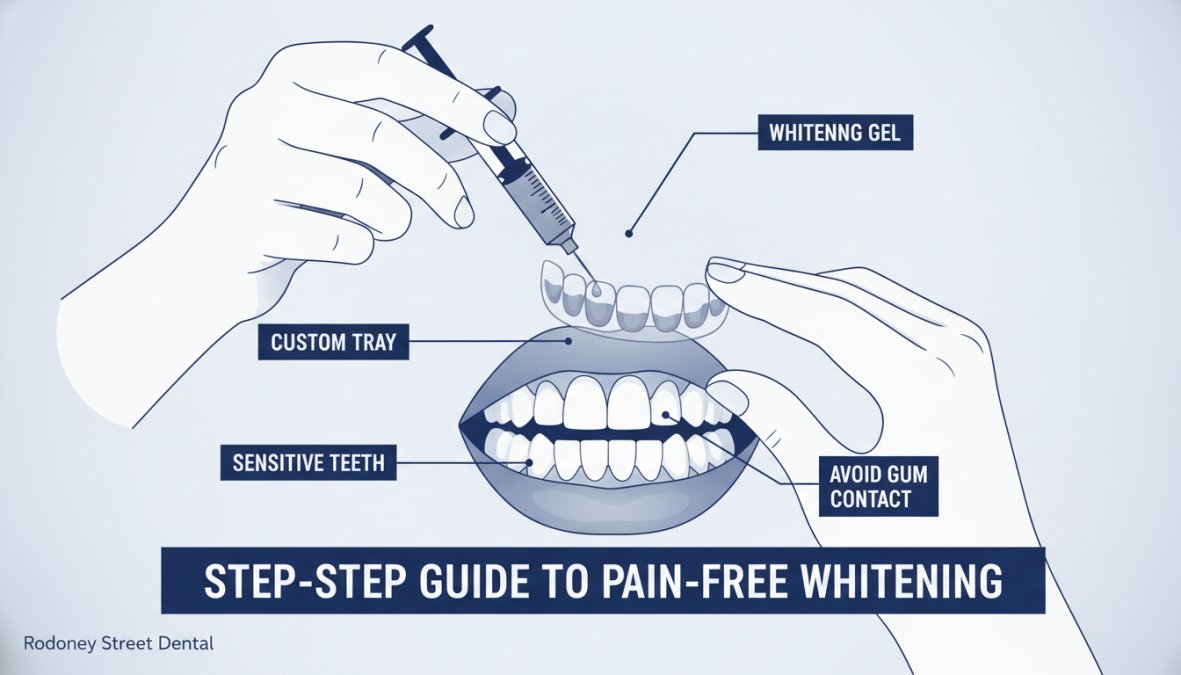
Application Process for Sensitive Teeth
For professional in-office whitening: Protective barriers are in place, whitening gel is carefully applied to the front surface of each tooth, an activating light may be used for 15-30 minutes, gel is rinsed off and reapplied for additional cycles, total treatment time is typically 45-60 minutes, and fluoride gel is applied after whitening to seal dentin tubules.
For at-home whitening with custom trays: Fill the custom tray with whitening gel, gently insert the tray and bite down to distribute gel evenly, wipe away excess gel from your gums, wear the tray for the recommended duration (typically 30 minutes to 2 hours), remove and rinse thoroughly, apply a sensitivity gel or fluoride rinse, and repeat nightly for 7-14 days as directed.
For over-the-counter whitening strips: Dry your teeth completely, apply strips to your upper and lower teeth, leave strips on for the recommended time (typically 30 minutes), remove and discard strips, rinse your mouth, apply a sensitivity gel or fluoride rinse, and use strips once daily for 7-10 days.
Every application method should include a sensitivity relief step (fluoride or potassium nitrate) immediately after whitening.
Common Mistakes to Avoid During Whitening
Mistake 1: Overextending application time. Using whitening strips or trays longer than recommended doesn't accelerate results, it only increases sensitivity.
Mistake 2: Whitening too frequently. Whitening more than once every 3-4 weeks prevents enamel remineralization between treatments.
Mistake 3: Using high-concentration products without professional guidance. Stick to products labeled for sensitive teeth or use professional treatments under supervision.
Mistake 4: Ignoring pre-treatment sensitivity. Pre-treatment desensitization reduces sensitivity by 40-50%.
Mistake 5: Continuing acidic foods during whitening. Avoid citrus, soda, wine, and sports drinks for 48 hours before and after whitening.
Mistake 6: Whitening while experiencing existing sensitivity. Wait until baseline sensitivity resolves before proceeding.
Mistake 7: Skipping post-whitening fluoride treatment. Fluoride seals dentin tubules and prevents sensitivity from developing.
Whitening Products Comparison for Sensitivity
| Product Type | Sensitivity Risk | Timeline | Cost | Best For |
|---|---|---|---|---|
| Professional in-office whitening | Low (with pre-treatment) | 1 session, 60 min | Higher | Immediate results, maximum control |
| Custom at-home trays + gel | Low-moderate | 1-2 weeks daily use | Moderate | Gradual results, professional formulation |
| Over-the-counter strips | Moderate-high | 7-10 days daily use | Low | Budget-conscious, convenience-first |
| Whitening toothpaste | Very low | 4-6 weeks | Low | Maintenance, gentle ongoing whitening |
| Peroxide-free whitening | Very low | 2-4 weeks | Low-moderate | Severe baseline sensitivity |
Whitening Strips vs. Gels vs. Trays for Sensitive Teeth
Whitening strips offer convenience but present sensitivity challenges. They contain moderate peroxide concentrations (5-14%) and don't fit your teeth precisely. Excess gel leaks onto your gums, causing irritation. For sensitive teeth: strips are the riskiest option.
Whitening gels in custom trays are significantly safer. Your dentist provides lower-concentration gel formulated with sensitivity-protective ingredients. Custom trays fit precisely, preventing leakage. For sensitive teeth: custom trays are the best at-home option.
Professional whitening gels applied in-office are the gold standard for sensitive teeth. Your dentist applies protective barriers, uses professional-strength gel under supervision, and applies post-treatment desensitization. For sensitive teeth: professional whitening is worth the investment.
Peroxide-free whitening is safest for severe baseline sensitivity. Results are modest and slow, but sensitivity risk is virtually nonexistent. For sensitive teeth: peroxide-free options are your safest bet if you have severe baseline sensitivity.
If you've been avoiding teeth whitening because of sensitivity concerns, you don't have to miss out on a brighter smile. The key is choosing a method that prioritizes protection alongside results. Professional whitening at Rodney Street Dental includes pre-treatment desensitization, protective barriers, and post-whitening fluoride application, delivering dramatic results with minimal sensitivity. Contact Rodney Street Dental today to discuss a customized whitening plan that addresses your sensitivity concerns and delivers the confident smile you deserve.
Frequently Asked Questions
Can you whiten sensitive teeth without pain?
Yes, you can whiten sensitive teeth with the right approach. Use ADA-accepted products containing potassium nitrate and fluoride, which provide sensitivity relief while whitening. Professional whitening from a dentist allows for controlled hydrogen peroxide concentrations and protective measures. Pre-treatment with desensitizing toothpaste for 2-3 weeks before whitening significantly reduces discomfort. Avoid high peroxide concentrations and always follow application instructions carefully to minimize gum irritation and pain.
What is the best whitening toothpaste for sensitive teeth?
The best whitening toothpaste for sensitive teeth contains potassium nitrate and fluoride, which protect enamel while gently removing surface stains. Look for formulas that are SLS-free and alcohol-free to avoid additional irritation. ADA-accepted whitening toothpastes offer clinical efficacy without excessive bleaching agents. Dentist-recommended brands often provide superior results with minimal sensitivity. Apply twice daily as part of your oral health routine, and consider using a soft-bristled toothbrush to prevent enamel damage and further sensitivity.
How long does tooth sensitivity last after whitening?
Tooth sensitivity after whitening typically lasts between a few hours to several days, depending on your teeth's baseline sensitivity and the whitening method used. Professional whitening may cause brief sensitivity that resolves within 24-48 hours, while at-home treatments might produce sensitivity lasting 3-7 days. If sensitivity persists beyond two weeks, consult your dentist. Using fluoride-based sensitivity relief products and avoiding acidic foods during recovery accelerates remineralization and reduces discomfort duration.
How do I stop my teeth from hurting after whitening?
To reduce tooth sensitivity after whitening, implement post-whitening recovery protocols immediately: use sensitivity toothpaste containing potassium nitrate and fluoride, avoid acidic foods and beverages, and apply fluoride gel or rinse before bed. Remineralization is key, consider professional fluoride treatments from your dentist. Take over-the-counter pain relief if needed, avoid teeth grinding, and don't repeat whitening until sensitivity fully resolves. If pain is severe or persists beyond one week, contact your dentist to rule out enamel damage or other oral health issues.
This article was written using GrandRanker