 comparison
Fastbraces vs Invisalign for Adults: Which Suits You?
Table of Contents
- Fastbraces vs Invisalign for Adults: Key Differences at a Glance
- Treatment Duration: Speed of Results
- Fastbraces Cost UK: What You'll Invest
- Invisalign Cost UK: Pricing and Payment Options
- Clear Braces for Adults UK: Aesthetics and Discretion
- Comfort and Convenience: Daily Life Impact
- Pros and Cons: Making Your Decision
- Long-Term Stability and Retention
- Making Your Final Decision
- Frequently Asked Questions
Last Updated: July 29, 2026
Fastbraces vs Invisalign for Adults: Key Differences at a Glance
When adults consider orthodontic treatment, the choice between Fastbraces and Invisalign hinges on three critical factors: treatment timeline, aesthetic preferences, and lifestyle compatibility.
Fastbraces use a triangular bracket and single square wire system to move both the crown and root of teeth simultaneously, delivering results in 3 months to 1 year. Invisalign relies on custom-made, removable clear aligners that gradually shift teeth over 6 to 24 months depending on case complexity.
Treatment Duration: Speed of Results
Fastbraces typically deliver comprehensive tooth straightening in 3 months to 1 year. The triangular brackets and single square wire apply consistent force to move both crown and root simultaneously, with noticeable changes often visible within 4 to 8 weeks. The speed advantage matters most for adults with mild-to-moderate crowding, spacing issues, or bite problems not requiring extractions.
Invisalign typically ranges from 6 to 24 months, with most straightforward cases completing in 12 to 18 months. The timeline depends on case complexity, patient compliance (wearing aligners 20-22 hours daily), and the number of trays needed.
| Treatment Option | Typical Timeline | Fastest Cases | Most Complex Cases |
|---|---|---|---|
| Fastbraces | 3-12 months | 3 months | 12 months |
| Invisalign | 6-24 months | 6 months | 24 months |
For professionals with upcoming events, Fastbraces often deliver measurable results within 6 months.
Fastbraces Cost UK: What You'll Invest
Fastbraces in the UK typically start from £1,850 for a single arch or £2,500 for comprehensive treatment of both arches using metal brackets. Clear ceramic brackets generally incur an additional cost of £250 to £500 per arch. Total investment depends on malocclusion complexity, whether extractions are necessary, your orthodontist's experience, and location. Many practices offer payment plans spreading costs across treatment duration.
Invisalign Cost UK: Pricing and Payment Options
Invisalign in the UK typically ranges from £1,500 to £5,800, with most adults paying between £3,500 and £4,500 for comprehensive treatment. Pricing follows a tiered model based on case complexity: Invisalign Express (minor corrections) sits at the lower end, whilst Invisalign Comprehensive (complex malocclusion) reaches the upper range.
Your initial consultation includes 3D digital scanning and a ClinCheck treatment plan predicting exactly how many aligners you'll need, which determines your final cost. Because treatment typically spans 12 to 18 months, monthly payments often feel more accessible than a single upfront cost.
Clear Braces for Adults UK: Aesthetics and Discretion
Invisalign's primary advantage for adults is aesthetic: the aligners are virtually invisible during normal conversation. Made from smooth, flexible plastic without metal wires or brackets, they eliminate the "metal mouth" appearance that concerns many mature patients. You remove aligners before meals, meaning no food restrictions and no trapped debris around brackets.
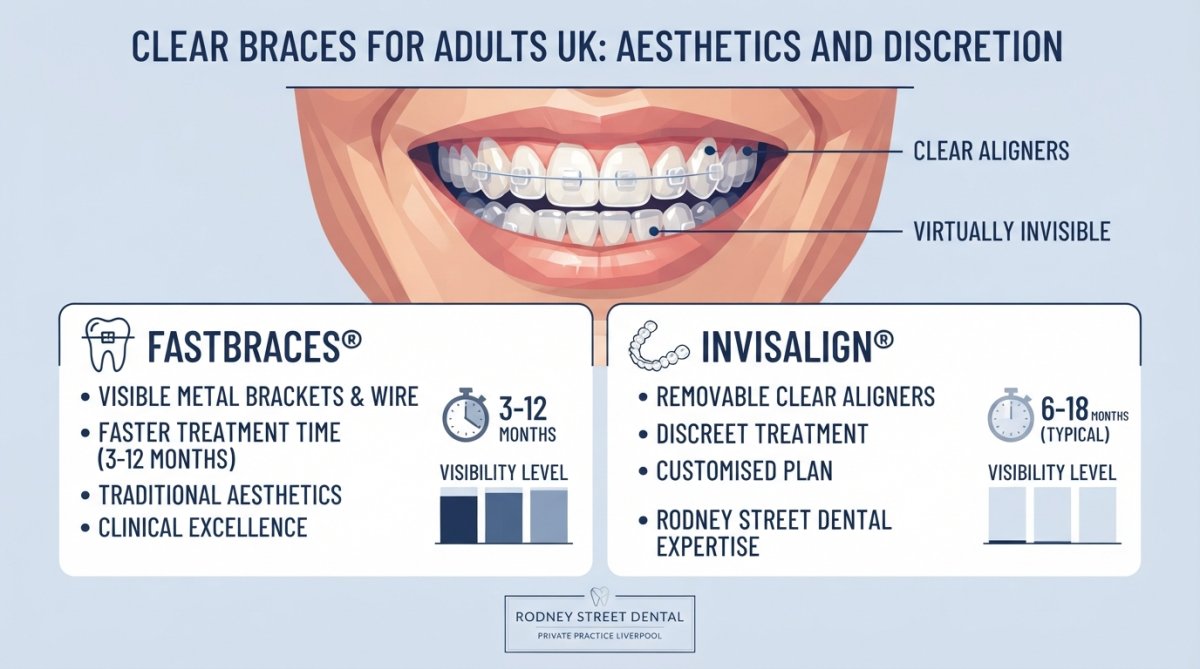
Fastbraces, even with clear ceramic brackets, remain visible at close range. For adults in client-facing roles or deeply concerned about appearance during treatment, this distinction matters significantly. However, Invisalign's invisibility creates a compliance risk; because aligners are removable, some adults underestimate the importance of consistent wear. Fastbraces' fixed nature eliminates this temptation.
Comfort and Convenience: Daily Life Impact
Fastbraces use less force than traditional braces, which many patients report translates to reduced initial discomfort. The first few days after activation often involve mild soreness, but most adults adapt within a week. The fixed nature means no daily decisions: brackets and wires stay in place, requiring no removal or conscious compliance.
Invisalign aligners feel smooth against gums and lips, causing minimal irritation. However, they require active management: removal before eating and drinking anything but water, cleaning before reinsertion, and consistent tracking of which aligner you're wearing. Speech can be affected temporarily with both systems, though most adults report this resolves within a week.
Pros and Cons: Making Your Decision
Fastbraces Advantages:
- Significantly shorter treatment duration (3-12 months)
- No compliance burden; fixed appliance ensures predictable progress
- Often avoids tooth extractions
- Results visible within weeks
Fastbraces Limitations:
- Visible brackets and wires
- Initial discomfort during adjustment period
- Dietary restrictions (avoiding hard, sticky, or crunchy foods)
- Regular adjustments required every 4-6 weeks
Invisalign Advantages:
- Nearly invisible treatment
- Removable for eating, drinking, and oral hygiene
- Smooth plastic aligners cause minimal irritation
- No dietary restrictions
Invisalign Limitations:
- Requires strict discipline: 20-22 hours daily wear
- Longer treatment timeline for most cases
- Aligners can be lost or forgotten
- May not suit extremely complex malocclusion
Invisalign suits: Adults prioritising discretion, those comfortable with daily aligner management, professionals who can maintain consistent wear.
Long-Term Stability and Retention
Both systems require retention after active treatment ends. Fastbraces typically involve a fixed bonded retainer on the back of your front teeth, combined with a removable night retainer. Invisalign treatment concludes with a similar retention protocol: a bonded retainer plus removable aligners or custom retainer worn nightly. Relapse rates are comparable between systems when patients follow retention protocols. Fastbraces' speed advantage compounds here: you transition to the maintenance phase faster, with visible brackets coming off in 6-12 months rather than 18-24 months.
Once your orthodontic treatment is complete, many adults choose to enhance their smile further with teeth whitening, which can brighten teeth that may have been stained during the treatment period and give you a truly radiant result.
Making Your Final Decision
The Fastbraces vs Invisalign comparison isn't about which system is objectively superior, but about alignment with your circumstances. Ask yourself three questions:
First: How much time do you have? If you need visible results within 6 months, Fastbraces deliver. If you're comfortable with gradual change over 12-24 months, Invisalign works.
Second: How important is appearance during treatment? If you interact with clients frequently or feel self-conscious about visible appliances, Invisalign's discretion outweighs other considerations.
Third: How disciplined are you with daily commitments? Invisalign demands consistent wear; forgetting aligners derails progress. Fastbraces demand nothing beyond attending regular appointments.
At Rodney Street Dental in Liverpool, we offer both Fastbraces and Invisalign as part of our comprehensive orthodontics service, supported by bespoke treatment plans, video walkthroughs, and a fully-qualified team committed to delivering clinical excellence and compassionate care. Discover how clear aligner technology works to understand the science behind your options, or contact us to discuss which system aligns with your goals. Your consultation includes 3D scanning and a detailed treatment timeline, no obligation, just clarity about what's possible.
Frequently Asked Questions
Is Fastbraces cheaper than Invisalign in the UK?
Fastbraces and Invisalign have different pricing structures depending on case complexity and your chosen provider. Fastbraces typically uses a per-arch pricing model, whilst Invisalign often uses tiered pricing based on treatment complexity. For an accurate comparison, you'll need to obtain quotes from your orthodontist, as costs vary by clinic. Your specific dental needs will significantly influence the final investment for either system.
Which is faster: Fastbraces or Invisalign for adults?
Fastbraces generally offers faster treatment duration, often ranging from 3 months to 1 year for comprehensive cases. Invisalign typically takes 6 to 18 months, though complex cases may extend longer. The speed difference comes from Fastbraces' simultaneous crown and root movement using triangular brackets and a single square wire. However, actual treatment time depends on your specific malocclusion and compliance with wearing aligners or maintaining braces.
Can Fastbraces treat complex orthodontic cases like Invisalign?
Both systems can address various malocclusion types, but they have different strengths. Fastbraces is designed for comprehensive cases and often avoids tooth extraction. Invisalign works well for mild to complex cases, though some extremely complex issues may be better suited to traditional fixed braces. Your orthodontist will assess your specific dental foundation, bite alignment, and tooth positioning to recommend the most suitable system for predictable results.
What's the difference in patient compliance between Fastbraces and Invisalign?
Invisalign requires high patient compliance, aligners must be worn 20-22 hours daily for effective results. Fastbraces, being fixed to your teeth, require no daily compliance regarding wear time, though you must maintain excellent oral hygiene around brackets and wires. For busy adults, Fastbraces removes the discipline required to remember wearing aligners, whilst Invisalign offers flexibility to remove aligners for eating and social events.
Do I need retainers after either Fastbraces or Invisalign treatment?
Yes, both systems require retainers after treatment to maintain long-term stability and prevent relapse. Retention is essential for preserving your investment and ensuring your teeth remain in their corrected position. Your orthodontist will provide specific guidance on retainer wear, some patients wear them nightly indefinitely, whilst others transition to occasional use. Proper retention is critical for sustained dental health and bite alignment.
This article was written using GrandRanker