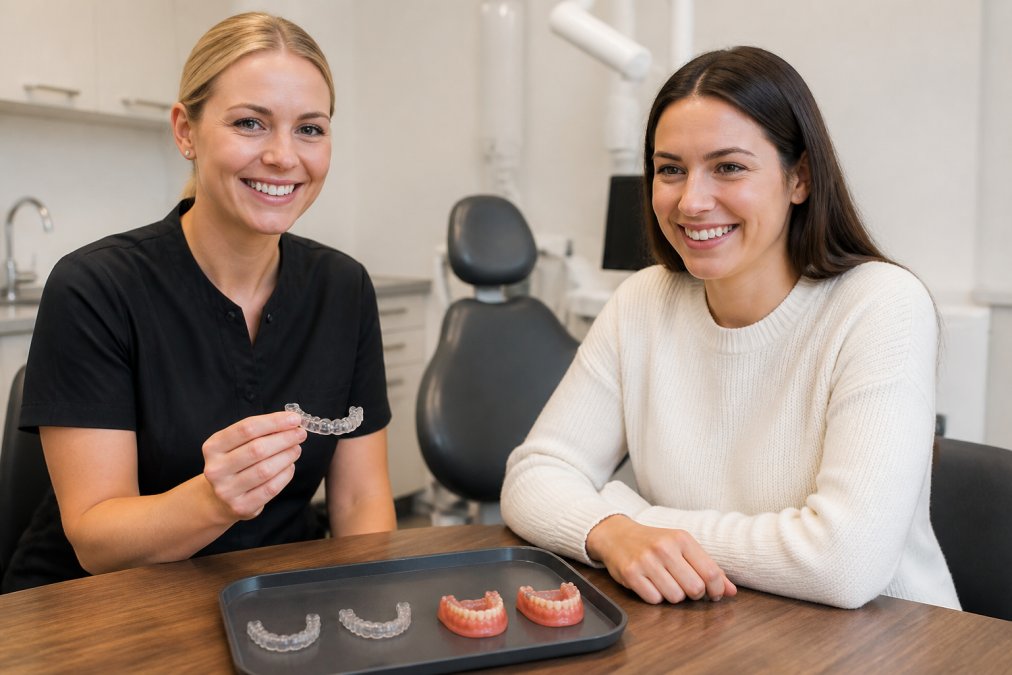
 comparison
Clear Aligners vs Retainers: Key Differences
Table of Contents
- Clear Aligners vs Retainers: What You Need to Know
- Key Differences Between Clear Aligners and Retainers
- How Long to Wear Retainers After Aligners
- Types of Orthodontic Retainers
- Featured Snippet Summary
- Frequently Asked Questions
Last Updated: August 12, 2026
Clear Aligners vs Retainers: What You Need to Know
Understanding the difference between clear aligners and retainers is essential if you're considering orthodontic treatment or have recently completed it. Clear aligners are active orthodontic devices designed to move your teeth into a straighter position over months, whilst retainers are passive appliances that maintain the results you've already achieved. The distinction matters because using one when you need the other can derail your progress or cause your teeth to shift back.
Key Differences Between Clear Aligners and Retainers
Purpose and function. Clear aligners actively move your teeth by applying controlled force over time. Each new tray is slightly different from the last, incrementally shifting your teeth toward their target position. Retainers hold your teeth in place after treatment without applying progressive force, simply maintaining alignment and preventing relapse, the natural tendency for teeth to shift back toward their original positions.
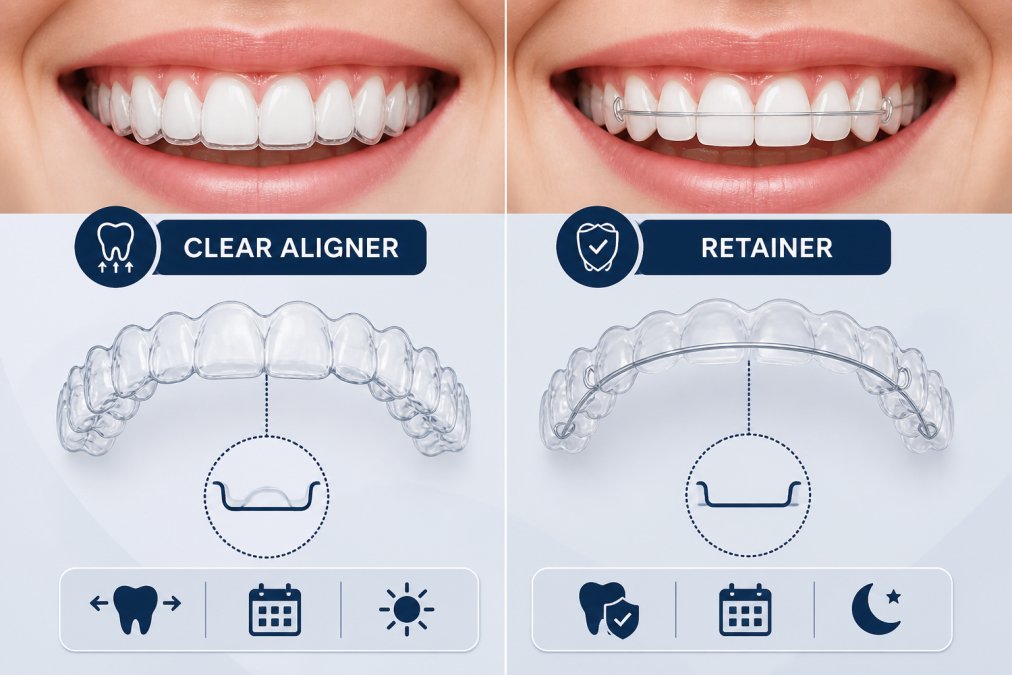
Active versus passive wear. During clear aligner treatment, your teeth are moving and your treatment plan progresses toward a specific endpoint, typically lasting 12-24 months. Once treatment ends, you enter the retention phase, where retainers take over indefinitely to prevent your teeth from drifting.
Material and durability. Clear aligners are made from proprietary thermoplastic polymers like SmartTrack material, engineered to apply consistent, gentle pressure, and are replaced every 1-2 weeks. Retainers are custom-fabricated clear plastic that can last 6 months to several years depending on the type and wear patterns.
Compliance and wear time. Aligners require strict compliance, you must wear them 20-22 hours daily for treatment to work as planned. Retainers, whilst still requiring consistent wear, are often more forgiving because they're not actively moving teeth. Many patients wear retainers nightly indefinitely.
How Long to Wear Retainers After Aligners
Immediately after treatment. Once your final aligner comes out, you transition directly to retainers. For the first 3-6 months, you'll wear them full-time: 24 hours daily except during meals and oral hygiene. This critical period stabilises your bite and allows your periodontal ligament and surrounding bone to remodel around your new tooth positions.
Months 6-12. After the initial stabilisation period, many patients transition to nightly wear. Wearing retainers every night during sleep maintains alignment without daytime inconvenience.
Beyond the first year. Some patients continue nightly wear indefinitely because teeth naturally shift throughout life. Others, under their dentist's guidance, may reduce to 3-5 nights per week after several years of stable results. The key is consistency: sporadic wear is less effective than regular wear.
Individual variation. Your specific retention timeline depends on the complexity of your original malocclusion, your age, your commitment to wear time, and your dentist's clinical judgment. Adults often need longer retention than teenagers because adult bone remodels more slowly.
Types of Orthodontic Retainers
Vivera retainers. Vivera retainers are premium clear retainers made by the Invisalign company using SmartTrack material. They're 30% stronger than standard clear retainers, custom-fabricated from digital scans, and typically supplied in sets of two to four pairs. They fit precisely and remain virtually invisible when worn, though they're more expensive than standard options and only available through Invisalign-certified providers.
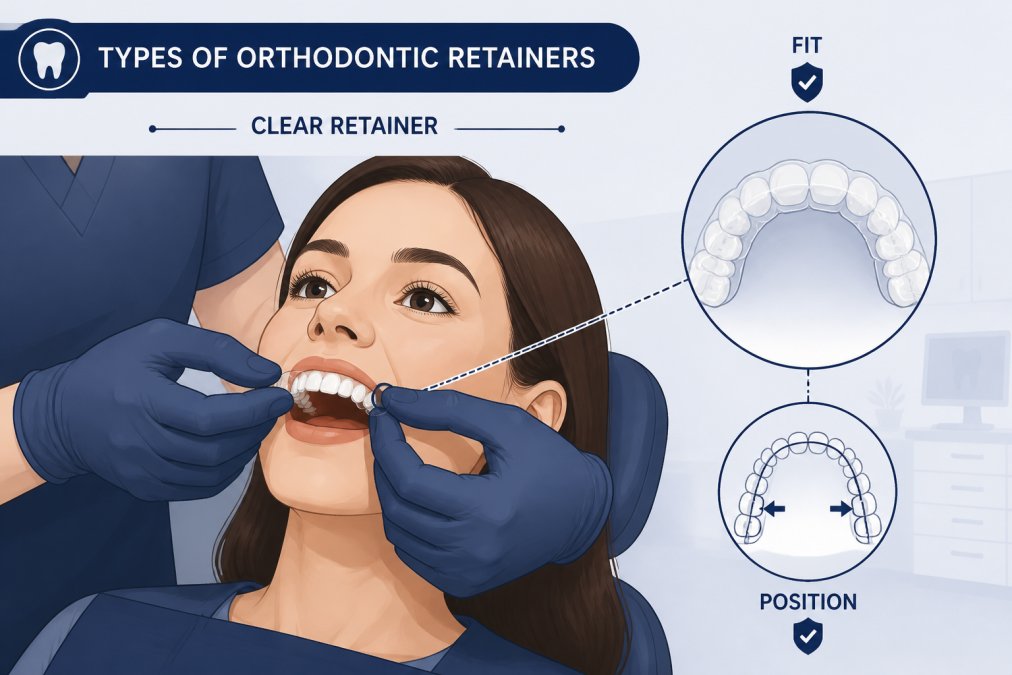
Essix retainers. Essix retainers are clear, custom-moulded retainers made from thin transparent plastic. They're affordable, virtually invisible, and easy to clean. However, they're less durable than Vivera retainers and typically need replacement every 6-24 months depending on wear patterns and care.
Fixed bonded retainers. A fixed retainer is a thin wire bonded permanently to the back of your front teeth. It's invisible from the front and requires no daily compliance. Fixed retainers are excellent for preventing relapse in the front teeth, though they can trap food and plaque, making oral hygiene more challenging.
Hawley retainers. Hawley retainers are the traditional option: a wire and acrylic framework custom-fitted to your mouth. They're durable and adjustable if needed, though visible when worn.
Featured Snippet Summary
| Aspect | Clear Aligners | Retainers |
|---|---|---|
| Purpose | Actively move teeth to correct malocclusion | Maintain tooth position after treatment |
| Phase | Active orthodontic treatment | Retention phase (indefinite) |
| Wear Time | 20-22 hours daily | Full-time initially; nightly long-term |
| Duration | 12-24 months typical | Months to years or lifetime |
| Material | SmartTrack or similar polymer | Clear plastic (Essix, Vivera) or wire (Hawley) |
| Replacement Frequency | Every 1-2 weeks (new trays) | Every 6 months to several years |
| Compliance Sensitivity | High, inconsistent wear delays results | Moderate, some flexibility in wear patterns |
You'll likely use both clear aligners and retainers at different stages of your orthodontic journey. Clear aligners straighten your teeth during active treatment, and retainers preserve those results for life. Once your orthodontic treatment is complete and your teeth are perfectly aligned, you may also wish to consider teeth whitening to enhance your newly straightened smile.
At Rodney Street Dental, we specialise in bespoke orthodontic treatment plans using trusted brands like Invisalign and Fastbraces, combined with comprehensive retention strategies tailored to your specific needs. Our fully-qualified team guides you through both phases with clear communication and compassionate care. If you're considering clear aligner treatment or need guidance on retainer options after completing orthodontics, contact us for a consultation where we'll discuss the best path forward for your smile.
Frequently Asked Questions
Can clear aligners be used as retainers after treatment?
Clear aligners are designed for active tooth movement during the treatment phase, not for retention afterwards. Once your orthodontic treatment is complete, your final aligners become too loose as teeth settle into their new positions. Retainers are specifically fabricated to maintain your teeth in their corrected alignment. Using old aligners risks allowing teeth to shift back. A proper retainer, whether fixed or removable, is essential for long-term stability after aligner therapy.
How long do I need to wear retainers after clear aligner treatment?
Retention is typically a lifelong commitment. Most orthodontists recommend wearing retainers every night indefinitely, though some patients transition to wearing them several nights per week after the first year. The retention phase begins immediately after your final aligner is removed. Teeth naturally want to shift back to their original positions due to periodontal ligament elasticity and bone remodeling. Consistent retainer wear prevents orthodontic relapse and preserves your investment in teeth straightening.
What happens if I stop wearing my retainers after aligner treatment?
Teeth will gradually shift back towards their original positions, a process called orthodontic relapse. This can happen within weeks or months of stopping retainer wear. The degree of relapse varies depending on your bite, gum health, and how long you wore aligners. Even small movements can affect your bite and smile aesthetics. This is why retention is considered the most important phase of orthodontic treatment. Consistent retainer wear prevents costly and time-consuming retreatment.
What are the main types of orthodontic retainers?
There are two primary types: fixed bonded retainers, which are thin wires bonded to the back of your front teeth and remain in place permanently, and removable retainers, which include clear plastic trays (like Vivera or Essix retainers) and traditional wire retainers. Fixed retainers provide constant retention but require careful flossing. Removable clear retainers offer flexibility and are nearly invisible but depend on patient compliance. Many orthodontists recommend a combination approach, fixed on lower front teeth and removable retainers for upper teeth.
Are clear retainers thicker than clear aligners?
Clear retainers are generally thinner than active aligners because they don't need to exert tooth-moving force. Aligners require sufficient thickness and rigidity to apply controlled pressure for tooth movement. Retainers, by contrast, are designed to be as discreet and comfortable as possible while maintaining position. Vivera retainers are made from SmartTrack material and are 30% stronger than standard clear retainers despite being thinner, allowing them to last longer. The reduced thickness makes retainers more comfortable for long-term wear.
This article was written using GrandRanker